
Table of Contents
1. Introduction
- Jean-Jacques Rousseau’s perspective on society and human happiness
- The link between civilization, mental states, and mood disorders
2. The Role of Expectations in Mood Disorders
- How expectations influence mental states
- Statistical and behavioral uncertainty in human interactions
- The internalization of expectations and communication barriers
- Rabindranath Tagore’s insight on the mind
3. Understanding Anxiety
- Definition and normalcy of anxiety in life
- When anxiety becomes a disorder
- Physical and psychological impacts
4. Stages of Anxiety (In Crescendo)
- 4.1 Excessive Worry
- Generalized Anxiety Disorder (GAD)
- Symptoms and diagnosis
- 4.2 Panic Attacks
- Definition and physical symptoms
- Prevalence and triggers
- 4.3 Uncontrollable Fear (Phobias)
- Specific vs. irrational fears
- How phobias develop from persistent anxiety
5. Types of Anxiety Disorders
- 5.1 Generalized Anxiety Disorder (GAD)
- Symptoms (e.g., chronic worry, irritability, physical ailments)
- Risk factors (gender, genetics, environment)
- 5.2 Phobias
- Specific Phobias (e.g., fear of animals, heights, environments)
- Social Anxiety Disorder (fear of judgment/embarrassment)
- Agoraphobia (fear of public spaces)
- List of Common Phobias (e.g., Acrophobia, Claustrophobia, Nyctophobia)
6. Epidemiology of Anxiety Disorders
- Global prevalence (post-COVID statistics)
- India’s anxiety crisis (stress and anxiety rates)
7. Anxiety in Children
- Normal childhood fears vs. anxiety disorders
- Four key features of childhood anxiety
- Parental challenges and treatment options
8. Causes of Anxiety Disorders
- Chemical imbalances (stress and mood regulation)
- Environmental triggers (trauma, chronic stress)
- Genetic predisposition
9. Treatment and Management
- Therapy and counseling
- Medication
- Non-invasive techniques (e.g., Transcranial Magnetic Stimulation – TMS)
10. Conclusion
- Summary of key points
- Encouragement for seeking help
11. References
‘Man is born free, and everywhere he is in chains’ – Jean-Jacques Rousseau
Jean-Jacques Rousseau (1712–1778), the visionary philosopher born in Geneva, emerged as one of the 18th century’s most influential thinkers. His work delved into the tensions between society and the individual, challenging the ideals of progress by arguing that civilization often eroded human happiness. Rousseau’s radical ideas—advocating a return to natural simplicity—laid the groundwork for modern discussions on psychology, governance, and the emotional burdens of societal expectations.1
Since, humans live in a society, they are interdependent, not independent. Mood like happiness / sadness depends on mental state of affairs like fear, love, expectations etc. Mood disorder and fear psychosis are the two main reasons for Anxiety disorder.
Expectation, probably one of the most important features that lead to mood variation and disorder. In expectation, we follow a statistical method by which related known values are used to estimate an unknown value or set of values. In most of the cases expectation is related to fellow human beings. But the behavioural aspect of a human being is uncertain because other individual may also have different perception, expectations. So expectations fail and that may lead to mood swings.
The irony is most of the time expectation is internal, seldom expressed. A human being normally can’t communicate or express all his thoughts for various reasons of her / his own, only one or two percent is expressed, and the rest circulates inside the mind.
The noble Laurette Rabindranath Thakur said, ‘The Mind Itself does not know the Mind’.
So, our mind is a dynamic concept. And mind is the cauldron of mood disorder.
What is Anxiety
Anxiety is a normal part of our life. we are all worry about its occurrences in our life from time to time. It causes to avoid places, people, and subject matter. Sometimes, it’s makes very hard to enjoy life. The good thing is that it’s treatable and help is available.
Anxiety disorders is a mental illness. They don’t come from personal weakness, character flaws or problems with upbringing. Ongoing research continues to investigate the underlying causes of anxiety disorders, exploring genetic, neurological, and environmental factors..
While fleeting fear is a natural human response to real threats, anxiety disorders involve persistent and excessive dread—even in the absence of actual danger. This heightened state of alertness, though biologically rooted as a survival mechanism, becomes disruptive when the mind falsely perceives threats where none exist. Occasional anxiety is universal, but when it lingers uncontrollably, it crosses into the realm of disorder.
Anticipating possible danger money worries due to loss of jobs, sick loved ones or environmental disaster etc. For people experiencing an anxiety disorder, though, this physical response happens often and feels overwhelming and hard to control.2 ‘Worry’, ‘keep worrying’, and ‘ continue to keep worrying’ is the tendency in case of Anxiety disorder.
anxiety disorder, usually last longer and are more intense. They often worsen over time and interfere with everyday life.
Generalized Anxiety Disorder (GAD) manifests uniquely in each individual—your experience may differ significantly from others’. Symptoms often fluctuate in intensity, sometimes changing throughout the day or in response to life circumstances. While stress itself doesn’t cause GAD, it can act as an amplifier, worsening existing symptoms and making them harder to manage.
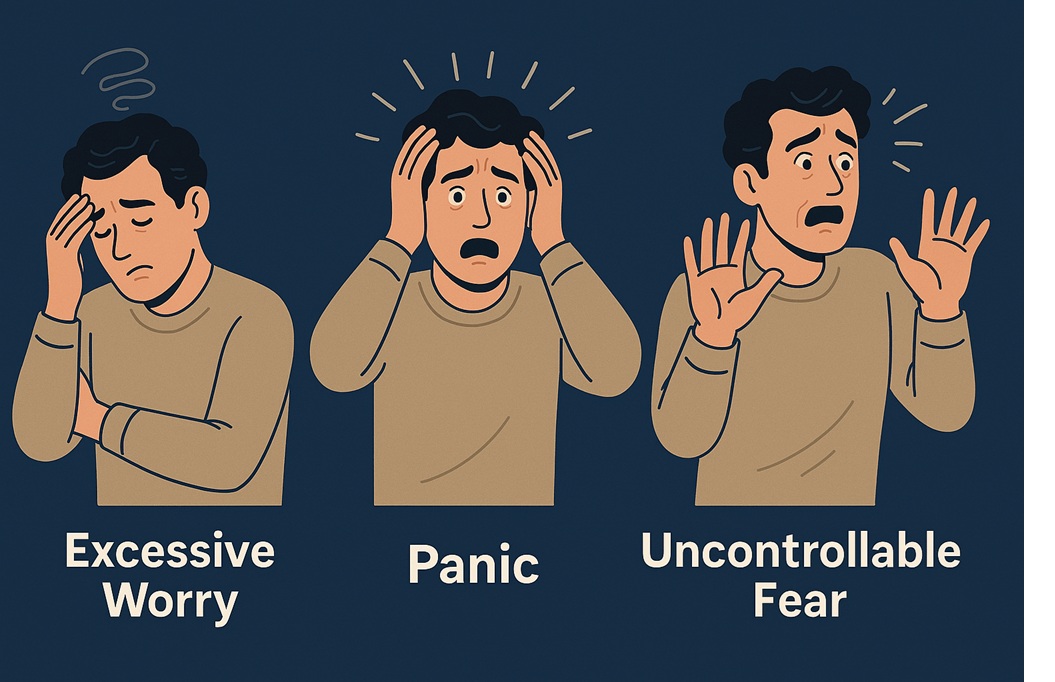
Anxiety is classified normally in three stages in crescendo.
Excessive Worry
Hard to enjoy life, situation ruled by doubt & suspicion. If one tends to worry a lot, even when there is no reason, One may have generalised anxiety disorder (GAD). GAD means that one is worrying constantly and can’t control the worrying. Healthcare providers diagnose the GAD as when one’s worrying happens on most days and continue for at least 6 months.5
Panic:
A panic attack is a sudden surge of overwhelming anxiety that triggers severe physical reactions despite no real danger being present. During an episode, individuals may experience a pounding heart, difficulty breathing, dizziness, uncontrollable trembling, and muscle tension. These intense episodes often strike without warning and may occur even when there’s no apparent trigger.
While frightening, panic attacks are surprisingly common – research suggests about one-third of people will experience at least one in their lifetime. Though sometimes called “anxiety attacks,” these episodes are typically more acute and intense than general anxiety symptoms.4
Uncontrollable Fear:
Uncontrollable fear represents an extreme, disproportionate response to a perceived threat.
When confronted with the object of their fear – whether a specific situation, place, or object – individuals may experience overwhelming dread or panic attacks. What distinguishes phobias from generalized anxiety is their consistent focus: when this intense fear becomes persistently attached to a particular trigger and recurs in predictable patterns, it crosses into the territory of a diagnosable phobia
Uncontrollable Fear & Phobias: When Fear Becomes Debilitating
1. The Nature of Uncontrollable Fear
Uncontrollable fear is an extreme, disproportionate reaction to perceived threats—whether real or imagined. When faced with their fear trigger (e.g., heights, spiders, or social situations), individuals may experience:
- Physical symptoms: Racing heart, sweating, trembling, or even full-blown panic attacks
- Psychological distress: Overwhelming dread or a primal urge to flee, despite knowing the fear is irrational [PubMed]
Example: Someone with arachnophobia (fear of spiders) might scream, freeze, or run away at the sight of even a harmless house spider.
2. Phobias vs. Generalized Anxiety
Unlike generalized anxiety (which is diffuse and worry-based), phobias are:
- Specific: Tied to a particular object/situation (e.g., flying, needles, or open spaces).
- Predictable: Symptoms always emerge when exposed to the trigger [NIMH]
- Persistent: Lasts ≥6 months and disrupts daily life (DSM-5 criteria) .
The Brain’s Role: The amygdala (the brain’s fear center) hyperreacts to phobic triggers, bypassing rational thought APA PsycNet
.3. Common Phobias & Physiological Roots
| Phobia Type | Example | Physiological Response |
|---|---|---|
| Animal | Arachnophobia (spiders) | Surge of adrenaline, heightened alertness |
| Situational | Claustrophobia (elevators) | Shortness of breath, chest tightness |
| Natural | Acrophobia (heights) | Dizziness, vertigo, leg weakness |
Why It Happens: Evolution wired humans to fear threats (e.g., snakes or heights), but phobias exaggerate this survival mechanism [Researchgate]
Imagine your brain’s alarm system getting stuck ‘on’—like a smoke detector blaring at a candle. Phobias work similarly: your body reacts to small threats as if they’re life-or-death.
Treatment Insight:
- Exposure therapy helps to retrain the brain’s fear response[ScienceDirect]
- Medications (like SSRIs – Selective serotonin reuptake inhibitors) can reduce physical symptoms .
Phobia is a type of Anxiety Disorder and have several types, to discuss later in this article.6
Not all Anxiety is a disorder
It’s normal for everyone to feel anxiety or fear at times—these emotions are natural and even helpful, as they prepare us to respond to danger. However, for some people, anxiety becmes excessive, persistent, and irrational. These overwhelming worries can be deeply distressing and may significantly interfere with daily life. This may indicate an anxiety disorder.4
Generalised Anxiety Disorder (GAD)
Generalized Anxiety Disorder is failure to cope with one’s internal stress is commonly known as GAD. Unique feature of GAD is, in a similar situation, like earthquake, flood wherein severe devastation took place in front the eyes – a traumatic situation, some people develop GAD and some are not. but it’s not understood why some people get it and others don’t. Researchers have identified the areas of the brain that control fear and anxiety are involved.
An anxiety disorder is a mental health condition characterized by excessive, uncontrollable worry that goes beyond normal stress or fear. Under Anxiety disorder, a person reacts to certain things and situation with fear and dread. Sometimes, the similar situation may lead to physical signs of anxiety, such as a pounding heart and sweating.
An anxiety disorder happens when:
- Anxiety interferes with one’s ability to function normally – normal response & reaction.
- Often overreact when something triggers the emotions.
- Uncontrolled responses to situations.
Anxiety disorders can turn daily life into an uphill battle—but they don’t have to. With the right treatment and support, relief and recovery are within reach nowadays. 7
Individuals with Generalized Anxiety Disorder (GAD) typically experience the following symptoms:
- expect the worst,
- Persistent, uncontrollable worry about finances, health, relationships, or work—even without apparent cause—along with an inability to relax or find peace in solitude,
- be unable to relax, enjoy quiet time, or be by themselves,
- avoid situations that make them anxious,
- be irritable,
- have difficulty concentrating or focusing on things,
- feel edgy, restless, or jumpy,
- feel easily fatigued,
- doubting everyone around,
- suffer from stomach problems, nausea, diarrhoea,
- suffer from poor sleep,
- Difficulty coping with not knowing future outcomes,
- Feeling restless, wound up, or on edge,
- Trembling or shaking,
- Being easily fatigued,
- Difficulty concentrating,
- Irritability,
- Muscle tension,
- Feelings of doom,
- Irrational worries about objects or situations,
- Difficulty controlling feelings of worry,
- Problems falling or staying asleep,
Who is at risk for anxiety disorders
Person’s risk for developing anxiety disorders is higher depending on a mix of genetic and environmental factors. Persons who have faced the following situation at higher risk to develop GAD or higher:
- Certain personality traits, such as shyness or behavioural inhibition — feeling uncomfortable with, and avoiding, unfamiliar people, situations, or environments.
- Exposure to stressful or traumatic events during childhood or adulthood.
- Genetic predisposition (family history of anxiety or related mental health disorders)
- Certain physical health issues, such as thyroid disorders or heart arrhythmias (irregular heart rhythms)
It has been observed that incidence of GAD in woman is higher and more often. Researchers, yet to find out reasons for such phenomenon.
Women’s hormones could be a reason, especially those that fluctuate throughout the month. Testosterone may also influence anxiety levels. Men typically have higher testosterone concentrations, which appears to have a moderating effect on anxiety responses. It’s also possible that women are less likely to seek treatment, so the anxiety worsens.7
In some cases, generalized anxiety disorder (GAD) symptoms can be triggered by medication side effects or substance misuse. It can also be related to medical conditions, such as hyperthyroidism, that increase hormones. This heightened state can increase nervous system excitability. Genetic predisposition and environmental stressors, including family dynamics, may contribute to GAD development. Additionally, chronic medical conditions can serve as triggering or exacerbating factors
PHOBIA
If Anxiety on a specific thing continues for a period of more than six months and increasing in crescendo, finally it becomes Phobia. This stage normally comes after the stage of ‘persistent uncontrolled fear for a period with specificity. A phobia is an intense, irrational, and persistent fear of a specific object, person, animal, activity, or situation. Individuals with phobias typically either avoid their feared trigger entirely or endure it with extreme anxiety and distress. 8
Some of these fears may make sense, but often, the level of fear doesn’t match the situation. Specific, and limited phobias are e.g., a person may fear only insects (Entomophobia) or dogs (Cynophobia).
By avoiding their specific fears, individuals with phobias can often live with minimal anxiety. Many adapt their lifestyles successfully to maintain happiness and comfort. However, in severe cases, a phobia may profoundly influence major life decisions—shaping career choices, daily commutes, social interactions, leisure activities, and even where they live.
There are three major types of Phobias:
Specific phobia (simple phobia). With this most common form of phobia, people may fear specific things like
- animals (such as dogs, cats, spiders, snakes),
- people (such as clowns, dentists, doctors),
- Common fear triggers include environmental factors like dark spaces, high elevations, and thunderstorms, as well as situational triggers such as airplane flights or train journeys or
- situations like, such as flying in a plane, riding on a train,
- being in a confined space.
These conditions tend to run in families, suggesting genetics play an important role..
Name of the Phobias (Anxiety Disorder)
- Acrophobia – Fear of Heights
- Agoraphobia – Fear of being in a public place
- Ailurophobia – Fear of Cats
- Androphobia – Fear of Men
- Anthropophobia – Fear of human companionship
- Arachnophobia – Fear of spiders
- Aviophobia – Fear of flying
- Bathophobia – Fear of deep places
- Claustrophobia – Fear of enclosed spaces
- Cynophobia – Fear of Dogs
- Cherophobia – Aversion to or fear of happiness
- Dentophobia – Fear of dentists or dental procedure
- Entomophobia – Fear of insects
- Ereuthrophobia – Fear of blushing
- Gamophobia – Fear of marriage
- Gephyrophobia – Fear of crossing a bridge
- Glossophobia – Fear of speaking in front of an audience
- Gymnophobia – Fear of seeing others naked or being seen naked or both
- Gynophobia – Fear of Woman
- Hedonophobia – Fear of experiencing pleasure
- Hemophobia – Fear of blood or injury
- Hypengyophobia – Fear of taking or neglecting one’s responsibility
- Hypnophobia – Fear of sleep
- Ichthyophobia – Fear of fish
- Mysophobia – Fear of Dirt
- Nostophobia – Fear of returning home
- Nyctophobia – Fear of right or darkness
- Ophidiophobia – Fear of snakes
- Pathophobia – Fear of diseases
- Pediophobia – Fear of children
- Phobophobia – Fear of phobias
- Psychrophobia – Fear of the cold
- Scopophobia – fear of being seen in public or stared at by others.
- Spectrophobia – Fear of mirrors
- Tocophobia – Fear of child birth
- Theophobia – Fear of God
- Triskaidekaphobia – Fear of number thirteen
- Zoophobia – Fear of animals
Social Anxiety Disorder (formerly called “social phobia”)
People with social anxiety disorder often fear being judged, embarrassed, or humiliated in social situations. This anxiety can be so intense that they may avoid social interactions altogether. Common triggers include the fear of being ridiculed, making a mistake in front of others, or feeling scrutinized—especially by unfamiliar people.
For some, the anxiety is specific to performance-based situations, such as public speaking, giving a presentation, or performing on stage. For others, the fear is more generalized, leading them to avoid everyday activities like eating in public or using a public restroom.
Social anxiety disorder appears to have a genetic component, as it often runs in families. Additionally, individuals who were shy or withdrawn as children—or who experienced negative or distressing social interactions early in life—may be more prone to developing this condition. 8
Agoraphobia: Fear of Trapped or Unsafe Situations
Agoraphobia is an anxiety disorder characterized by an intense fear of being in public places where escape might be difficult or help unavailable in case of distress. People with this condition often avoid situations like crowded events, public transportation, or even open spaces due to the fear of feeling trapped or humiliated.
Many individuals with agoraphobia also experience panic attacks, marked by overwhelming fear and physical symptoms such as trembling, rapid heartbeat, and sweating. In some cases, agoraphobia co-occurs with panic disorder, further intensifying the avoidance of certain environments.
Phobias in Childhood vs. Adulthood
Childhood phobias most often emerge between ages 5 and 9 and are typically short-lived. In contrast, persistent phobias usually develop later, particularly in one’s 20s. Unlike childhood fears, adult phobias tend to endure for years and rarely resolve without treatment.
Left unaddressed, phobias in adults can heighten the risk of other mental health conditions, including additional anxiety disorders, depression, and substance abuse.
How common are Anxiety Disorders
Global data from 2019 revealed that 301 million individuals were affected by anxiety disorders, with 58 million of those being children and adolescents. IHME’s GBD Compare Tool, THE LANCET PSYCHIATRY
Anxiety disorders are characterised by excessive fear and worry and related behavioural disturbances.10
A study reveals horrifying state of Anxiety in India. Mental illness stress, anxiety depression has reached all time high post covid situation. A report published in Indian express, on 20th December 2022 says that 74% Indians are suffering from stress and 88% from anxiety.9
So, Anxiety disorder is very common, not only in India but also for other countries as well.
How do Anxiety Disorders affect children?
Children and teenager are naturally developed some of anxiety, worry, fear of losing out in school in examination or games. A child may be afraid of barking dogs or thunderstorm.
Yet for some children, these scenarios trigger paralyzing anxiety, leaving them consumed by fear. These children often get “stuck” on their worries. Parents face tough times to reduce the anxiety levels of their children as most of the time these children ‘got stuck’ at certain point and extremely reluctant to try something new.
Getting stuck at some point does not relate to regular worries but an anxiety disorder. In such situation child’s ability to function got impaired and parents needs to seek help to reduce or remove the anxiety disorder from the children.7
Anxiety-related problems in children share four common features. The anxiety:
- Is typically a fear or fixation that interferes with the ability to enjoy life,
- Creates mutual bewilderment (confusion) between parent and child.
- No amount of sensible explanations seems to ease these worries
- Is treatable.7
The Complex Causes of Anxiety Disorders
While the exact causes of anxiety disorders remain unclear, researchers believe they likely result from multiple interacting factors:
- Neurochemical Factors
Prolonged or intense stress may disrupt the brain’s chemical balance, particularly in systems that regulate mood. Over time, these changes could contribute to the development of an anxiety disorder. - Environmental Influences
Traumatic experiences can trigger anxiety disorders, particularly in individuals with an inherited genetic vulnerability. This combination of external stressors and biological predisposition appears to create the highest risk. - Genetic Predisposition
Evidence suggests anxiety disorders often run in families, indicating a potential hereditary component that may make some people more susceptible when faced with environmental stressors.
Researchers continue to investigate how these biological, environmental, and genetic elements interact to produce different anxiety-related conditions. 7
We may conclude that as long as Anxiety is under control, its ok but as soon as Anxiety impairs our daily activities and functions, we need to be careful and seek help because Anxiety is treatable. Apart from Medicine, and counselling, a modern non – invasive technique TMS, which controls motor cortex function, is used nowadays to treat anxiety.
References
[1] British Library, Learning English timeline
[2] Mental Health Foundation of New zealand
[3] NIH, National Library of Medicines, NH Medline Plus Magazine
[4] Better Health Channel, Panic attack
[5] Johns Hopkins Medicine ,GAD
[6] healthline, Phobias
[7] Cleveland Clinic, Anxiety Disorder
[8] Harvard Health Publishing, Harvard Medical School, Phobia
[9] The Indian Express
[10] WHO world Health Organisation

Debasis Chaudhuri