
INDIAN Scenario on Mental Health & Market Potential
Index
- Concern of Government of India on Mental Health
- Indian Mental Healthcare Act 2017
- De-criminalizing Suicide Attempt
- Secures Human Rights
- Statistics on India
- National Mental Health Programme (NMHP)
- District Mental Health Program (DMHP)
- Clinical Trials Act 2019
- Resources & Health Professionals
- National Tele mental Health Programme
- Location of Tele MANAS Centre
- Organisational Framework
- Tele-MANAS calling mechanism
- Financial Aspects – Indian Suicide
- D & MDD in India
- India – a Natural choice for Multi nationals
GDP of the First Five Countries in the World
|
Name of the Country
|
GDP in US Dollars |
| 1st United States of America |
23.30 trillion $ |
| 2nd China |
17.70 trillion $ |
| 3rd Japan |
4.90 trillion $ |
| 4th Germany |
4.30 trillion $ |
| 5th India |
3.75 trillion $ [mint] |
Largest Economies of the world – wisevoter International Monetary Fund – IMF
India is the fastest growing market in Asia. The healthcare market was valued INR 17.62 trillion in 2020. It is expected to expand at a compound annual growth rate of CAGR 29.79% per annum during the 2021 to 2026 period to reach INR 81.30 trillion (992 billion US dollars) by 2026. Medical Buyer
Concern of Government on Mental Health
In December 2017, India President Ram Nath Kovind warned of a potential “mental health epidemic” in India, with 10 per cent of its 1.42 billion-strong population having suffered from one or more mental health problems.
“In a nation of 1.3 (should be 1.42 billion now) billion people, that was a staggering figure. The number of Indians suffering from mental health problem was larger than the entire population of Japan “– he (president of India) said. Economic Times
The Union Minister of State for Health and Family Welfare, Dr. Bharati Pravin Pawar stated this in a written reply in the Rajya Sabha (Upper house of the bicameral parliament of Indian) – “The rising statistics underscore the urgency of addressing depression in India to enhance the overall quality of life. While it may not be possible to prevent depression entirely, proactive measures can potentially mitigate recurrence in individuals who have previously experienced it”.
[Ministry of Health and Family Welfare – India]
This isn’t an overstatement to say that India is witnessing an emergency. Well beyond frightening figures, it is crucial to acknowledge that there is indeed a gap in how mental health is addressed in Indian society.
Mental health is the foundation for the well-being and effective functioning of individuals.
Mental Healthcare Act 2017
On 7th April 2017 a law was enacted in India to provide rights for mental healthcare and services for persons with mental illness and to protect, promote and fulfil the rights of such persons during delivery of mental healthcare and services and for matters connected therewith or incidental thereto. [Times of India]
The main features of the Act are:
- Recognising the rights of a mentally ill person
- Protects the rights of a person with mental illness, and
- thereby facilitating his/her access to treatment and by an advance directive; how he/she wants to be treated for his/her illness.
- De-creminalizing Suicide Attempt
- All mental health practitioners (clinical psychologists, mental health nurses, and psychiatric social workers) and every mental health institute will have to be registered with this authority.
- outlines the procedure and process for admission, treatment, and subsequent discharge of mentally ill persons.
- Act difines responsibility of certain other Agencies like imposes a duty on the police officer in the charge of a police station , duties of the Magistrate
- Defines specific Financial Punishment to the related person including a jail term upto 2 years
Decriminalizing Suicide Attempt
It decriminalizes suicide attempt by stating that a person who attempts suicide should be presumed to have severe stress and shall not be punished. It also imposes the government to rehabilitate such persons so that there is no recurrence of suicide attempts in future.
Secures Human Rights of People with Mental Illness
It ensures that every person has the right to access mental health services. Such services should be of good quality, convenient, affordable, and accessible. It also protects such persons from inhuman treatment and provides access to free legal services and their medical records.
Statistics
India is a Republic of several state or provinces, having 33 states and each state is having its own regulation for health. Each state Govt. can go for tender of buying items independently under the guidance of central government.
Total Population -1.42 billion
Number of Neurologists – 1200 Registered with the Indian Academy of Neurology. In one study,[Neurology in India] neurologists situated in district places reported of having to see approximately more than 80 patients every day. This no. is very high, but they need to attend the patients as no. of neurologist does not match with the demand.
In case of any TMS manufactures come to India / Asia, they need to consider this patient load aspect and so technologically, the cooling system of the TMS unit plays a very important role due to no. of usage (patient load) of TMS units in quick succession.
Number of Psychiatrists – As per the National Survey of Mental Health Resources carried out by the Directorate General of Health Services, between May and July 2002, against the required 11,500 psychiatrists in the country, only 3800 existed. The World Mental Health Atlas 2014 mentions the number of psychiatrists as 0.30 per 100,000 population.
There are only 5,000 plus psychiatrists in India, or 0.3 for every 100,000 persons, and less than 2,000 clinical psychologists (0.07 per 100,000). To compare, the ratio of psychiatrists in developed countries is 6.6 per 100,000 and the average number of mental hospitals globally is 0.04 per 100,000 persons, compared to 0.004 in India .[Indian Journal of Psychiatry]
In India, the treatment gap (the number of people with an illness who need treatment but do not get it) is 70 to 92 per cent, depending on the state. It is estimated that nearly one-third of patients who seek help from healthcare facilities could have symptoms related to depression. But poor awareness of mental health symptoms, social stigma, and lack of adequate resources and facilities stop people from getting the help they need.
Also, mental health services are highly inaccessible and up to 40 per cent of patients must travel more than 10km to reach the first available service at the district headquarters.
Although NATIONAL MENTAL HEALTH PROGRAMME (NMHP) was launched in India long back but in recent past the initiative gained momentum due to abnormal rise in medically non-treatable mental illness. [National Mental Health Programme]
In Indian context, Disability Adjusted Life Year (DALY) loss due to neuropsychiatric disorder is much higher than diarrhoea, malaria, worm infestations and tuberculosis if taken individually. Together these disorders account for 16% of the global burden of disease (GBD) in 2020. One in four families is likely to have at least one member with a behavioural or mental disorder.
These families not only provide physical and emotional support, most of them (>90%) remain un-treated.
Poor awareness about symptoms of mental illness, myths & stigma related to it, lack of knowledge on the treatment availability & potential benefits of seeking treatment are important causes for the high treatment gap.
The Government of India has launched the National Mental Health Programme (NMHP), with the following objectives:
- To ensure the availability and accessibility of minimum mental healthcare for all in the foreseeable future, particularly to the most vulnerable and underprivileged sections of the population.
- To encourage the application of mental health knowledge in general healthcare and in social development; and
- To promote community participation in the mental health service development and to stimulate efforts towards self-help in the community.
The District Mental Health Program (DMHP) was launched under NMHP in the year 1996 (in IX Five Year Plan). The DMHP was based on ‘Bellary Model’ with the following components:
- Early detection & treatment.
- Training: imparting short-term training to general physicians for diagnosis and treatment of common mental illnesses with limited number of drugs under guidance of specialist. The health workers are being trained in identifying mentally ill persons.
- IEC (Information, Education & Communication): Public awareness generation.
- Monitoring: the purpose is for simple Record Keeping. NMHP
Rise in the prevalence of chronic disease, growing investments from public and private investors, and the emergence of advanced technologies are some of the factors that drive the market. Relaxation of foreign direct investment (FDI) and increased government expenditure propelled the business during the 2016 and 2026.
Clinical Trials in India – The new rule, placed since 2019, is beginning to make India an attractive destination to do clinical trial as well. These new rules have brought India’s regulatory framework on par with US Food and Drugs Administration (FDA) norms.
As set forth in the 2019-CTRules and the Hdbk-ClinTrial, the Central Drugs Standard Control Organization (CDSCO) is the regulatory authority responsible for clinical trial oversight, approval, and inspections in India. In accordance with the provisions of the 2019-CTRules, the Drugs Controller General of India (DCGI) heads CDSCO, and is responsible for granting permission for clinical trials to be conducted and for regulating the sale and importation of drugs for use in clinical trials. (Note: The DCGI is commonly referred to as the Central Licensing Authority in the Indian regulations.)
In 2021, a UNICEF survey, around 14% of 15 to 24-year-olds in India reported frequently feeling depressed or disinterested.
In UNICEF survey across 21 countries, only 41 per cent of young people in India said that it is good to seek support for mental health problems, compared to an average of 83 per cent for 21 countries. [UNICEF report]
The World Health Organization’s 2015 report suggested that 4.5% of the Indian population, or approximately 56,675,969 people, were affected by depressive disorders. Imagine the current figures on people suffering from Depressive Disorder. [WHO]
Update on status of Mental Health Professionals and Resources in Indian States
25 States/ UTs have set up 38 Tele MANAS Cells and have started mental health services.
Posted On: 14 MAR 2023 4:56PM by PIB Delhi
For providing affordable and accessible mental healthcare facilities to the population, including the poor and underprivileged, the Government is implementing the National Mental Health Programme (NMHP) in the country. The District Mental Health Programme (DMHP) component of the NMHP has been sanctioned for implementation in 716 districts for which support is provided to States/UTs through the National Health Mission.
To improve the infrastructure of delivery process, Government is augmenting the availability of manpower in the under-served remote areas of the country by providing online training courses to various categories of general healthcare medical and para medical professionals through the Digital Academies, since 2018.
Govt. established on-line centres at the three Central Mental Health Institutes. The number of trained professionals under Digital Academy for the year 2019 – 2020 are as follows:
|
Serial No. |
Name of the Institute |
No. of Professionals trained |
|
1. |
National Institute of Mental Health and Neurosciences (NIMHANS), Karnataka state | 16313 |
|
2. |
Central Institute of Psychiatry (CIP), Jharkhand State |
371 |
|
3. |
Lokopriya Gopinath Bordoloi Regional Institute of Mental Health (LGBRIMH), Assam state |
219 |
Table 1 For the year 2019 – 2020
The mental health services are available at three Central Mental Health Institutions as mentoring establishments viz. National Institute of Mental Health and Neurosciences (NIMHANS), Bengaluru, Central Institute of Psychiatry (CIP), Ranchi, Lokopriya Gopinath Bordoloi Regional Institute of Mental Health (LGBRIMH), Tezpur, All India Institute of Medical Sciences (AIIMS) and Medical Colleges.
The data regarding number of people who have sought treatment for mental health issues since 2019-20, State/UT-wise, is not maintained centrally. However, number of people seeking treatment for mental health issues in three Central Mental Health Institutions, viz. National Institute of Mental Health and Neurosciences (NIMHANS), Bengaluru, Central Institute of Psychiatry (CIP), Ranchi and Lok Priya Gopinath Bordoloi Regional Institute of Mental Health (LGBRIMH), Tezpur since 2019-20 is given as under:
No. of patients in outdoor clinic (OPD) and patient needs to hopitalised(IPD) in three nodal centres
|
Serial No |
Institute | Outpatient Department (OPD) Patients in Clinics |
In-Patient Department (IPD) Hospitalisation |
||||
|
2019 – 2020 |
2020 -2021 | 2021 -2022 | 2019 – 2020 | 2020 -2021 |
2021 -2022 |
||
|
NIMHANS |
189,539 | 88,036 | 238,615 | 19,490 | 10,406 |
3181 |
|
|
LGBRIMH |
125,564 | 59,573 | 81,472 | 1,855 | 1,016 |
1342 |
|
|
CIP |
98,789 |
58,601 | 97,491 | 4,892 | 2,203 | 4332 | |
Table 2
Facilities made available under DMHP (District Mental Health Programme) at the Community Health Centre (CHC) and Primary Health Centre (PHC) levels, include outpatient services, assessment, counselling/ psycho-social interventions, continuing care and support to persons with severe mental disorders, drugs, outreach services, ambulance services etc.
Mental health services have been added in the package of services under Comprehensive Primary Health Care under Ayushman Bharat – HWC Scheme. Operational guidelines on Mental, Neurological, and substance use disorders (MNS) at Health and Wellness Centres (HWC) have been released under the ambit of Ayushman Bharat – a scheme launched by Central govt.
The Revolutionary Tele MANAS project
Besides the above, the Government has launched a “National Tele Mental Health Programme” known as Tele MANAS on 10th October 2022, to further improve access to quality mental health counselling and care services in the country. As on 09.03.2023, 25 States/ UTs have set up 36 Tele MANAS Cells and have started mental health services. 63806 calls have been handled on the helpline number.
Tele MANAS is a novel attempt on the part of Indian Govt. to reach out fur-flung areas and to overcome the social taboo and stigma as the patients can speak from the privacy of their homes and so, can hide their identity.
NATIONAL TELEMENTAL HEALTH PROGRAMME IN INDIA
24X7 tele-mental Health Services available on Toll Free Number- 14416 or 1-800-91-4416
Establishing a new milestone in the field of mental health on the occasion of World Mental Health Day last year 10th October 2022, Tele Mental Health Assistance and Networking Across States, known as Tele-MANAS an initiative of Union Ministry of Health & Family Welfare was launched by Mr. Thawar Chand Gehlot, Hon’ble Governor of Karnataka State at National Institute of Mental Health and Neurosciences (NIMHANS), Bengaluru, in the presence of Dr. K. Sudhakar, Minister for Health & Family Welfare and Medical Education, Karnataka & Vice-President, NIMHANS. Acknowledging the mental health crisis in wake of the COVID-19 pandemic and an urgent need to establish a digital mental health network that will withstand the challenges amplified by the pandemic, Government of India announced National Tele Mental Health Programme (NTMHP) in the Union Budget 2022-23. Tele-MANAS aims to provide free tele-mental health services all over the country round the clock, particularly catering to people in remote or under-served areas. The programme includes a network of 25 tele-mental health centres of excellence.
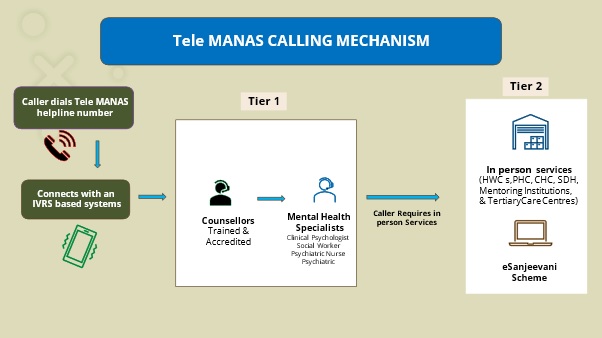
Tele-Manas will not only help in providing immediate mental healthcare services, but also facilitate continuum of care. Specialised care is being envisioned through the programme by linking Tele-MANAS with other services like National tele-consultation service, e-Sanjeevani programme, Ayushman Bharat Digital Mission, mental health professionals and emergency psychiatric facilities.
The Government has also supported 19 Government medical colleges/institutions/Public hospitals to strengthen 47 Post Graduate Departments in mental health specialties. Additionally, the government is supporting implementation of the District Mental Health Programme (DMHP) under the National Mental Health Programme in 716 districts of the country for detection, management and treatment of mental disorders/ illness with the major components of counselling in schools and colleges, work place stress management, life skills training, suicide prevention services and Information, Education and Communication (IEC) activities for generation of awareness and removal of stigma associated with Mental Illness.
Location of Tele-MANAS centres – a part of Govt. initiatives:
- AIIMS (All India Institute of Medical Science) – Patna, Bihar State,
- AIIMS – Raipur, Chhattisgarh State,
- CIP – Ranchi, Jharkhand State,
- AIIMS – Bhopal, Madhya Pradesh State,
- AIIMS – Kalyani, West Bengal State,
- AIIMS – Bhubaneshwar, Odissa State,
- PGIMER – Chandigarh, Punjab State,
- Hospital for Mental Health – Ahmedabad, Gujarat State,
- Inst. of Psychiatry and Human Behaviour – Bambolim Goa State,
- AIIMS – Nagpur, Maharashtra,
- AIIMS – Jodhpur, Rajasthan,
- KGMU – Lucknow, Uttar Pradesh,
- AIIMS – Rishikesh, Uttarakhand,
- IHBAS – Delhi, Delhi,
- IGMS – Shimla, Himachal Pradesh
- Psychiatric Diseases Hospital, Govt. Medical College – Srinagar, Jammu & Kashmir,
- LGBRIMH – Tezpur, Assam
- NIMHANS – Bengaluru, Karnataka,
- IMHANS – Kozhikode, Kerala,
- IMH – Chennai, Tamil Nadu
- IMH – Hyderabad, Andhra Pradesh
- JIPMER and AIIMS, Mangala Giri.
- Other States include -Andaman and Nicobar Islands, Dadra Nagar Haveli and daman and Diu, Ladakh, Rajasthan, Telangana, West Bengal.
Eventually, this initiative will include the entire spectrum of mental wellness and illness and integrate all systems that provide mental health care which includes investment on equipment like TMS and others.
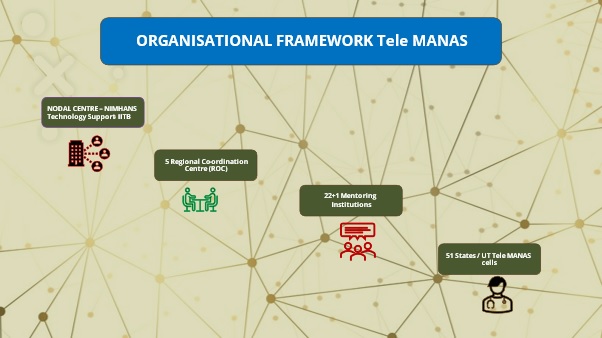
Working of Tele MANAS scheme
click here for the website
Why Indian Govt. is so serious about Mental Health Treatment programme!
Answer lies in two reports of WHO.
Suicides in India – A total of 1,64,033 suicides were reported in the country in 2021 which is an increase of 7.2% in comparison to the previous year in terms of total numbers. In terms of rate of suicide, India reported a rate of 12 (per lakh population) and this rate reflects a 6.2% increase during 2021 over 2020.[Indian Journal of Psychiatry]
Financial Aspect of Indian Suicides in India in 2015
Money impacts live and dead alike. If it is not there, even the dead are deprived of due procedural ceremonies. Suicide is a public health hazard and ranks high among deaths in India. With such a high rate and consequent wastage of human resources and investment, the cost of suicide is bound to be high and hence Govt. has shown its concern and move forward with Mental Health Programme.
Needless to mention depression precedes suicide so catch them young. The earlier the better.
There were no major reports on financial aspects of suicide from India so far. Hence, an exercise was undertaken to compute the net cost of suicide in India, for the year 2015. Poduri Gopala Sarma – National Library of Medicine
A total of 133,623 persons committed suicide in 2015. They lost 4,349,158 years in total while living for slightly more period of 4,777,293 years. Post suicide, the expenses were 152,233.8 trillion with a saving of 29,200 trillion. During the lifetime they lived, these people generated an income of 1,672,198 trillion and cost 320739.3 trillion. The net cost of suicide was ‘ 149,313.9 trillion. The figures are even bigger in 2022.
This study is good enough to change the mindset of a Govt. having a population of 1.42 billion, to go after a programme to introduce measures and steps to revitalise the mental health of Indians as effective treatment options are available globally both Medication and TMS.
Depressive and Major Depressive Disorder in India
Depression has multiple risk factors – biological (genetic, chronic diseases, terminal illness), psychological, social (familial, relationships, violence, disasters), cultural (religion, caste, beliefs, attitudes), economic etc. Depending on the severity of symptoms, it can be categorized as mild, moderate, or severe.
In India, the National Mental Health Survey 2015-16 revealed that nearly 15% Indian adults need active intervention for one or more mental health issues and one in 20 Indians suffers from depression. It is estimated that in 2012, India had over 258 000 suicides, with the age-group of 15-49 years being most affected WHO
According to a World Health Organisation (WHO) report, India has the highest number of depressed individuals in the world. This means that one out of three individuals in India suffers from depression. It is expected that in the next ten years, depression will put more burden on nations than any other disease, as per the World Bank.
As per the “The Burden Of Mental Disorders Across The States Of India: The Global Burden Of Disease Study 1990 – 2017” which was published in The Lancet Psychiatry on December 20, 2019, in 2017, 197.3 million people were suffering from various mental disorders in India that is one in seven or 14.3 per cent of the population. The Pioneer
The contribution of mental disorders to the total disease burden in India in terms of disability adjusted life years (DALYs) increased from 2.5 per cent in 1990 to 4.7 per cent in 2017. One DALY is at least one lost year of ‘healthy’ life. [Indian Express]
Depression accounted for 33.8 per cent of all mental disorder DALYs in India in 2017, followed by anxiety disorders (19%), idiopathic developmental intellectual disability (10.8%), and schizophrenia (9.8%).
YLDs made up all the DALYs from mental disorders in 2017, except eating disorders, for which YLDs made up 99·8% of the DALYs. Mental disorders were the leading cause of YLDs in India, contributing 14·5% of the total YLDs in 2017.
The highest contribution to DALYs due to mental disorders in India in 2017 was from depressive disorders (33·8%, 29·5–38·5) and anxiety disorders (19·0%, 15·9–22·4), followed by IDID (10·8%, 6·3–15·9), schizophrenia (9·8%, 7·7–12·4), bipolar disorder (6·9%, 4·9–9·6), and conduct disorder (5·9%, 4·0–8·1; table 1). The contribution of depressive disorders and eating disorders to the total DALYs was substantially higher in females than in males, whereas the contribution of autism spectrum disorders and ADHD was significantly higher in males than in females. The Lancet Psychiatry
Mental health is the foundation for the well-being and effective functioning of individuals.
Among all the countries in the mentioned region, Indian Govt. has taken realistic and positive measures, including budget allocation and target to cover specified Geography, to improve the infrastructure of imparting the mental health treatment facilities to its citizens.
Hence Indian market offers a huge potential and is now open for investment in modalities and in mental hospitals. Number of seats for neurology and psychology, are being added to different medical colleges and mental health institutes to improve the ratio of doctors to population.
Some of the countries in Asia and adjoining region, launched patient Data Protection Act, in line with HIPPA – USA. This helps the patients to overcome social stigma and taboos as medical history of a patient is protected through legislature.
This paper is useful to portray the market prospect for the Indian as well as Foreign Hospital investors. Also, for that fact the paper is equally important to modality manufacturers like TMS (single-pulse, paired pulse, or repetitive TMS (rTMS etc.)
Commercially, serving a high growth rate market with existing high captive market potential, having psychological and neurological infrastructure in public hospitals, complete on-line coverage of a huge geography coupled with high population density like India and supported by legality, return on investment would be much quicker.
Due to the huge untapped market potential for mental illness like DD, MDD, Anxiety etc ,in Asia and adjoining geography, this is the right time for the manufacturers of TMS units to come out of the traditional market of TMS i.e. Europe and USA rather to target Asia, MENA and region.
Asia-Pacific Transcranial Magnetic Stimulator Market Regional Analysis By Type [Single or Paired Pulse TMS and Repetitive TMS (rTMS)], Age Group (Adults and Children), and Application (Research, Diagnostics, and Therapeutics) is expected to reach US$ 499.10 million by 2028 APAC forecast
Ministry of Health and Family Welfare, India, in no longer at the planning stage but at the execution level. Launching Mental Health programme, introducing new laws for protecting the patient data and defining the rights of the mental patients, opening clinics to reach out and spread the awareness to attract private investments and most importantly, ready to go for PPP (Private-Public Partnership) model.
WHY INDIA IS A NATURAL CHOICE TO MAKE AN ENTRY IN Asia, MENA and ASPAC regions FOR MOST OF MULTINATIONALS
Among all the countries in the mentioned region, Indian Govt. has taken realistic and positive measures, including budget allocation and target to cover specified Geography, to improve the infrastructure of imparting the mental health treatment facilities to its citizens.
Since, there is a cultural difference between Europe and Asia, taking a decision on investment in Asia is not that easy. But the market size of Asia, MENA and ASPAC region is too big to ignore.
And now the situation is such that ‘first come – fast gain’ the age-old principle of marketing is meaningful and relevant in this context.
To choose a Business Model is a complex process which requires assistance of an expert. The bottom-line for any Brand to entire a market is to generate confidence of the market in terms of training, post sales service, easy availability of consumables and finally product registration for a specific country.
The Indian Economy is buzzing and witnessing growth rapidly. As a developing nation the Indian market provides a very sustainable environment MNC’S and other Business. The economy is also favourable to business as it remains stable and continues to grow.
The reasons for the investors on TMS for investing in India are:
- India is the most important among emerging market in Asia – CAGR 18% (global average 9.5%)
- Political stability with a responsive administration.
- Well established judiciary to establish rule of law.
- Progressive simplification and rationalisation of tax structure – direct and indirect.
- Robust Banking and financial institutions.
- Large population size – 1.42 billion and 15 to 20% are suffering from mental illness – Huge untapped market potential.
- Comparatively skilled manpower is cheaper.
- Very high level of technically skilled and educated personnel available as job seekers.
- Growth Market in healthcare – expected CAGR 29%
- Rate of return on Investment is comparatively quicker due to market size and growth rate,
- Fifth largest economy Globally thus disposable income for the middle-class citizens is increasing steadily looking for a better life and adopt better means of treatment,
- Social Stigma and Taboo are first depleting as education level is fast improving, in some states educational level is 99% in India.
- Active participation of the Govt. to treat mental illness after being recognised the loss to society due to Mental illness is in trillion dollars for a population size of 1.42 billion.
- has opened Mental clinics, as infrastructure, in 25 nos. of public hospitals in different states with a budget allocated to procure modalities and other equipment.
- A separate programme has been launched like recruiting professionals, training for the existing professionals etc. known as National Mental Health Programme (NMHP) launched under the National Health Scheme in last year’s World Mental Health Day on 10th October 2022.
- To reach to 1.42 billion people, Ministry of Health & Family welfare has launched an on-line portal known as Tele-MANAS (in Indian language MANAS means MIND). This on-line portal is really a game changer to spread the awareness among 1.42 billion population very fast which otherwise is impossible. So, the first level treatment / guidance can be had from the comforts of his / home & thus social stigma & taboo don’t come in the way.
- At least, there are 10 numbers of State level associations for Neurologists and psychologists & psychiatrists exist in India, with a central body for respective professionals. Every year they hold state level as well as central level events, like holding conferences and Trade fairs.
- Due to numerous medical colleges and universities in India, lot of Indian pass-out professionals are working in other neighbouring countries of Asia, MENA and ASPAC region.
- Govt. of India has taken an open mind stand to accept and spend on new technology to offer a better life to the citizen of India, who are suffering from DD, MDD etc. Probably India is the first country in Asia who has taken up mental health so seriously and accordingly has taken up measures, financially and administratively to implement a scheme.
- Enacted Clinical Trial Act 2019 to facilitate trials for the manufacturers like TMS units within India.
- India is very conveniently located geographically. India’s position is almost at the centre of APAC region, as a result most of the countries in Asia can be reached within a short time, Southeast Asia and MENA regions. There is not wide time gaps among the different countries in Asian region.
Companies like Apple, Siemens, GE healthcare, Airbus, Mercedes, BMW, Skoda etc. have come to India with manufacturing units due to conducive atmosphere and strict compliance regulation to safeguard Foreign Direct Investment. India received FDI (foreign direct investment) $84.8 bn in services in Financial Year 2022 [FDI Times of India]
Government of India’s commitment is reflected in the National Mental Health Programme (NMHP), which encompasses life-skills training and counselling in educational institutions, workplace stress management and suicide prevention services, among others. At the primary care level, the Health, and Wellness Centres under the Ayushman Bharat program have a provision for mental healthcare services. [Health Ministry].
Government of India has started the initiative to treat mental health probe issues through Tele-Manas scheme and make people aware of. Only the TMS unit manufacturers are absent in these efforts of Govt. of India though the TMS units are required in India urgently.
Going forward, for the investors and TMS unit Manufacturers, this is the right time to entire Asia, MENA and ASPAC region which represents 65% of Global population. On an average 16 to 18 percent (approximately) of this huge population has been suffering from Depressive Disorder, Major Depressive Disorder, Anxiety etc.
Commercially investment on TMS is now viable as it is in use in USA and Europe and also obtained FDA certificate. This paper shows that, an underlying demand already exists in Asia especially in India, reaching out is the only issue.
Debasis Chaudhuri